
The Final Statement
‘Crime cannot defeat the police, illness must not drive out the doctor, and problems in society cannot overcome journalism.’
During the Soviet era, children in Khakassia were persistently taught to love the writer Arkady Gaidar. Among them was my contemporary, Tatyana Solomatova, a ninth-grade student at Secondary School No. 19 in Abakan. In the autumn of 1992, Tanya read in Sobesednik that her hero had been implicated in the execution of hundreds of surrendered soldiers of the Tsarist army in Crimea. This vile slander against Arkady Petrovich outraged the young Tatyana so deeply that she decided to refute the accusations against the writer once and for all by finding examples of his noble deeds.
Tatyana turned to the republican archives, where the girl encountered the other side of life for the first time–a side that confronted her with a difficult moral choice.
He devised a practice of executing children in front of their parents, and vice versa, that defied comprehension and paralysed both reason and soul. He often killed completely illiterate peasants who were entirely innocent. He executed teenagers he considered suspicious. He drowned men en masse from uluses, aals, and villages. The future idol of children in Khakassia became so accomplished in his bloody trade that even his immediate superior, Kakoulin, commander of the Special Purpose Units (ChON) in Yenisei Governorate, was forced to rein in the young Khakas commander, confronting him with a number of horrific crimes.
Gaidar was saved by powerful patrons, while his terrible atrocities against the republic’s inhabitants were concealed, and Khakassia was forced to love and glorify its own executioner.
Thus, the young Tanya Solomatova faced a difficult choice–to turn away from the terrible truth and preserve her illusions, or to follow her conscience and tear the mask of virtue from a bloodthirsty fiend. Fifteen-year-old Tanya chose to tell the truth, doing what another world-renowned writer, Mark Twain, had taught Soviet children: ‘You will never go wrong if you do the right thing.’
With the help of her history teacher, Boris Grigoryevich Chuntonov, Tatyana wrote a paper entitled ‘The Activities of the Special Purpose Units (ChON) in the Achinsk and Minusinsk Districts of Yenisei Governorate in 1922–1924.’ Solomatova and Chuntonov submitted their research to the renowned writer Vladimir Soloukhin, who was holding a literary evening in Abakan. Tatyana’s work shocked the writer so profoundly that, after gathering additional information, Soloukhin wrote The Salt Lake, a book about Gaidar’s atrocities in Khakassia. Its publication in 1994 was financed by Mikhail Khrolenko, a prominent Abakan businessman at the time.
Tanya Solomatova is undoubtedly a hero. It was people like her whom the incomparable Mikhail Saltykov-Shchedrin had in mind when he said that in youth, a person is more sensitive to the suffering of others…
But if we examine The Salt Lake from a legal standpoint, it is defamatory or even, with a little effort, deliberately and knowingly false!
The information published in the book contains not a single piece of evidence that Gaidar was involved in even one of the crimes attributed to him. Nor does the book prove that these crimes were ever committed at all. The entire work is based on accounts by local residents. The archival documents cited in the book are only indirectly related to Gaidar. Although they contain important information, such as the names of executed children and the unfavourable assessment of Arkady Petrovich given by his own commanders, they contain no documentary evidence directly linking Golikov to any particular crime. From the standpoint of legally proving Arkady Gaidar’s guilt, all of this amounts to absolutely nothing–mere words, sometimes anonymous, and nothing more.
According to Soloukhin, people were drowned in ponds, but the executioners sent their unfortunate victims underwater only in lakes. And there is absolutely no evidence that Gaidar personally executed 76 elderly women and their grandchildren, both boys and girls, with a machine gun in an unnamed village.
Believe me, if one set out to do so, it would be possible to use legal technicalities alone to dismiss Tanya Solomatova’s and Vladimir Soloukhin’s entire work outright as knowingly false and justifiably brand both of them as slanderers. Had criminal proceedings been brought against them, they would have been unable to provide the investigative authorities with a single documentary piece of evidence supporting their accusations against Gaidar.
Because ordinary citizens are not investigators.
I hardly need to tell you, especially here in a courtroom, that eyewitness testimony alone–particularly when much of it is anonymous–is insufficient grounds for bringing charges against Gaidar. From the standpoint of the Criminal Code, those who circulated unsubstantiated claims about the brave commander are more likely to be regarded as fraudsters.
The same can be said of any literary work based on real events. Take, for example, I Was in That War by Vyacheslav Mironov, a Krasnoyarsk writer and former military officer. How, tell me, could he legally prove that he and his subordinates had to take down the body of a conscript from Abakan who had been crucified? And in his immortal novella The Death of Ivan Ilyich, based on a real-life story, Leo Tolstoy described how the first thought that occurred to the colleagues of Ivan Mechnikov, a judge of the Tula District Court, upon his death was how they might advance their own careers.
But how is any of this possible? The events actually happened, yet from a legal standpoint, they never took place at all. What is more, anyone with the courage to assert that these events did occur could easily find themselves branded a criminal.
How can literature, or any form of creative expression, exist if legal technicalities can be used to dismiss any free thought or even an entire work?
Jurisprudence is a soulless discipline, whereas creativity is an ongoing process of exploring life and humanity’s place in it, society’s ills, and ways to heal them. It is a constant search for answers to the questions of the present, as well as the mysteries and enigmas of the past. The great scientist Vladimir Vernadsky said that all research seeks to discover humanity’s place in the world, while the writer Mikhail Saltykov-Shchedrin maintained that a noble idea must never stand still, not even for a moment. For only a continuous process of renewal can save society from descending into barbarism.
Creativity is the pulse of life. It is the realm in which the future frees itself from the vices of the past and the present. Legal science operates on the basis of established facts, whereas creativity is guided by the right to freedom of expression. Jurisprudence safeguards order and justice within the state, while creativity stands guard over the natural course of life and every person’s right to a future. Legal science protects the state as a unified organism, while creativity serves the common good.
Yet the state, with its monopoly on prosecution and punishment, is inherently more powerful than creative expression, which draws society’s attention to its afflictions through the artist’s brush, the writer’s words, the composer’s music, and the journalist’s pen. A writer who explores the depths of human nature and society has neither the powers nor the duties entrusted to the ‘guardians of the law’–police officers, investigators, and prosecutors.
Journalists, the guardians of society, cannot conduct operational-search activities, formally interrogate witnesses to events or incidents, seize documents, photographs, and video recordings, or conduct face-to-face confrontations in order to prove, if necessary, the impeccable legal validity of their articles at a later date. A journalist’s only tool is the word. It is the right of a person to share information (including anonymously), as well as opinions, assessments, and judgements. A journalist’s source may provide copies of documents. And the ‘guardian of society’ may exercise the right to draw their own conclusions and make their own assessments of the event being investigated.
A journalist cannot and should not be expected to possess perfect expertise or impeccable legal precision when recounting a story they are covering. If law enforcement officers, investigators, prosecutors, and even judges make mistakes despite having a powerful, multi-tiered system of oversight designed to ensure legality, procedural accuracy, and the separation of decision-making at different stages of a case, then a journalist investigating society’s ills and injustices against individuals–a journalist who is forced to rely solely on the words of interviewees and sources–cannot, given the nature and limitations of the profession, be held responsible for establishing irrefutable legal proof of the events described in their work. Still less should they bear such a burden of responsibility merely because they are suspected of making a mistake or even accused of having made one or more mistakes.
Legal facts must not so ruthlessly suppress a journalist’s professional duty and right to investigate life and society’s ills. Such an approach is simply unfair to those whose only means of defending their fellow citizens is to write an article. A journalist draws attention to a problem in society; they do not set out to establish legal facts and prove the truth in their articles.
But how, given this obvious contradiction, can two opposing forces coexist in the same space: the soulless discipline of jurisprudence and the natural human need to investigate and understand our own lives, discuss their shortcomings, and seek remedies for society’s common ills? How can an established legal fact coexist with a right that is constantly being sought and explored? Both sides matter, and life is simply unimaginable without either of them. The most precise answer was given more than 150 years ago by the great French writer Victor Hugo: ‘This struggle between right and fact has continued since the dawn of society. To end the duel, to fuse the pure idea with the reality of human life, to make right peacefully enter the realm of fact, and fact the realm of right–that is the task of the wise.’
In the same work, the same author called the law the second soul of man. And journalism has long been recognised throughout the world as the soul of society. The soul will always fight for life, its continuation, and progress. Yegor Bradke, a prominent nineteenth-century Russian statesman, spoke of the written word that stands guard over society’s interests as follows: ‘The letter of the law may stand in the way of what is good, but given the imperfection of all human relations, to circumvent it is to risk causing even graver misunderstandings… One must never forget that, in essence, it is merely a servant of the spirit, helping to safeguard the spirit’s demands amid the corruption of human relations… If this relationship is not strictly maintained, the spirit will lose its rightful significance, the entire state and social order will collapse, and all that remains, as a tombstone inscription, will be a dead letter.’
Yet the written word, whatever meaning it conveys or whatever problem it addresses, can only be printed on paper and read. A legal fact, however, can have far-reaching consequences.
In 1937, the last romantic of Khakassia, regional leader Mikhail Torosov, submitted a written proposal to grant Khakassia the status of an autonomous region within Soviet Russia. For this, he was executed after being declared a spy who, acting on the instructions of the enemies of the state, had been preparing to separate Khakassia from Russia and had already drawn up a concrete plan to that end. Torosov’s desire to improve life in his small homeland and for every one of its inhabitants was declared a crime. He was sentenced to death, and this verdict was officially recognised as an established legal fact.
An apology came 50 years later, accompanied by the words: ‘Those were the times.’ Khakassia has since become a separate federal subject of Russia, yet to this day, the location of Torosov’s burial remains unknown. I used to tend to his symbolic grave, and each time I did, I wondered: ‘What for? Why? Who benefited from his death?’

Mikhail Afanasyev in court. Photo: Alexey Tarasov / Novaya Gazeta.
Hugo said: ‘The clash of principles is like the clash of natural forces… The king defends royal power, while democracy defends the people.’
Such is the way of the world: the authorities and society are polar opposites. The authorities and their mouthpiece, politics, form a soulless, cynical mechanism. They are alien to the lofty ideals of humanity, the enduring value of fighting for one’s fellow human beings, and compassion for the pain of others. Indifference is inherent in power; it is its backbone and foundation. This is only natural: grass is green, however much it might wish to be multicoloured. If the authorities were guided exclusively by ideals of love for one’s neighbour, they would hardly be able to perform their functions. In times of political threats, upheaval, and crises, any government uses all its might to protect its own interests alone, just as any person, when faced with danger, devotes every effort to saving their own life.
But crises come and go. Those who were your greatest enemies yesterday may become your best friends tomorrow. In 1983, the downing of a South Korean civilian Boeing carrying hundreds of passengers came within a hair’s breadth of triggering a nuclear war. Five years later, the South Korean government invited the USSR to participate in the Seoul Olympics and, in return, promised to drop its claims over the downed airliner. If the relatives of the victims and the press had learned of such a cynical political bargain struck at the expense of their loved ones’ memory, it would have caused a worldwide scandal. This example, along with hundreds of others, demonstrates that the authorities place their own interests above universal human values–and readily make a complete U-turn whenever it suits the political agenda. That is the nature of power.
Society, however, and journalism as the voice of its interests, cannot afford the luxury of changing their priorities to suit the prevailing winds. Society must either strive for justice and the eradication of its common ills, or cease to exist as a society at all. In the face of any catastrophe, people help one another, and that is what makes us human. Otherwise, as Chekhov put it, there is ‘paralysis of the soul’. Society has values, and those values have remained unchanged for centuries: compassion, mutual support, mercy, and love for one’s neighbour. The authorities may change their interests, but society can never abandon its values.
Journalism is the guardian of society. It responds to every individual’s pain and to the ills afflicting society as a whole. It investigates the causes of the disease and proposes remedies. Political crises will always arise for those in power, international tensions will escalate, and economic conflicts will erupt. And those in power will always fight to protect their interests and preserve the status quo in the spheres under their control. That is their very nature. Journalism, however, cannot betray the values of its profession. No matter how difficult things may become, there must always be people–at least one person–who constantly remind those in power that, beyond their own interests, there is a human being in the state they govern.
That person is alive. They want to live, to love, to raise children, to belong to a shared, noble ideal that is close to their heart, and to leave behind a good memory of themselves. There must always be people willing to speak up for a police officer and report on problems within the police force. Someone must tell the public about the hardships faced by doctors. Someone must expose the arbitrary dismissal of an ordinary worker, so that respect for working people becomes the norm. A person is not to blame for wanting to live rather than die because of their superior’s stupidity and negligence. Nor is a journalist to blame for seeking to help that person, as their professional duty requires. As the great Nikolay Nekrasov asks in his verse: ‘What nobler purpose could the lyre serve than to draw the attention of the mighty to the people?’
There can be nothing inherently subversive about using the written word to fight for people. Beneath a police uniform, a doctor’s white coat, or a worker’s overalls is a human being who wants to live and to remain engaged with what happens in their own life. And all of us, together, want to live in a just and safe society. But no one is going to build such a society for us.
Journalists stand guard over society’s interests. Just as a police officer has no right to turn away from a crime, a journalist cannot look away from injustice simply because the interests of one alcoholic mediocrity have suddenly become entangled with a geopolitical crisis facing those in power, potentially harming innocent people in the process. A journalist cannot shy away from a complex issue simply because it might be interpreted differently.
Journalism betrays the very nature of its profession when it evades the investigation of injustice–and, above all, its causes. ‘When we discover the cause,’ wrote the great scholar of humanity Vladimir Ivanovich Vernadsky in his article ‘War and the Progress of Science’, ‘we can easily solve the problem, and humanity then develops in the right direction.’ The legendary Soviet journalist Anatoly Agranovsky taught that journalism’s primary function is to seek an answer to the question: ‘What lies at the root of our problems?’
Without the desire to get to the truth, without the intention of healing society of the affliction it has uncovered, journalism loses its purpose. Above all, without the willingness to lend a helping hand to one’s fellow human being, the very idea of humanity disappears.
In the 1880s, Mikhail Saltykov-Shchedrin reflected on this subject in words that remain strikingly relevant today: ‘Why, when I see a person helpless, am I not allowed to offer them a helping hand? Why, when I have the opportunity to give someone useful advice, am I instead obliged to pollute their minds with well-intentioned absurdities? After all, human nature itself inclines us to sympathise with our fellow human beings and to wish to raise their spiritual level to our own! Why must I deny myself the fulfilment of this natural impulse? And why, if I refuse to do so, must I explain myself to the district police officer?’ (‘Abroad’, 1881).

Mikhail Afanasyev at a court hearing. Photo: Network Freedoms.
Undoubtedly, every journalist has an interest in uncovering a high-profile story about officials abusing their power against an individual or, say, embezzling public funds. This is part of what journalism is about, and it is what readers expect. But can one imagine a more noble sight than a doctor seeking to identify diseases and find ways to rid the body of them? Is it fair to accuse, say, a shoemaker who strives to repair shoes to a high standard of trying to establish a reputation as a skilled professional? And can a police officer be accused of dishonesty for making every effort to solve a high-profile crime? Yet in my case alone, the desire to do something useful for the common good–the very idea of using words in the service of society–has been labelled a motive for committing a serious crime. I quote: ‘In an effort to draw increased attention to himself and his journalistic activities.’
The great composer, poet and singer Alexander Vertinsky considered attracting attention to oneself and one’s creative work the most difficult task of all, while actors at the Chekhov Moscow Art Theatre refused to go on stage if their names were missing from the programme. My daughter Sofia, who was still very little at the time, would not perform at her dance classes unless I was watching from the audience. And my son Ivan would ask his grandmother to send me photos whenever he set a new record for the number of laps he ran.
Rembrandt painted himself into Christ in the Storm on the Sea of Galilee. The artist Nikolai Ge hung on a cross to understand what Jesus had been thinking, while Leo Tolstoy watched and said, ‘That is how it was.’ The desire to share one’s achievements and talents with the world is inherent in human nature. Yet I alone, simply because I am an individual and practise journalism, am forbidden from attracting attention to myself, because in my case alone this is deemed a motive for a serious crime.
Until mid-2022, the European Court of Human Rights, whose judgments on professional journalistic laws and standards were applicable in Russia under Article 15 of the Russian Constitution, clearly defined journalism’s role in the state as that of a ‘public watchdog’ and a ‘guardian of society’. In the same way, a police officer is a ‘guardian of the law’, a prosecutor ensures that it is properly enforced, and a court safeguards the law. But my profession is utterly defenceless when the absolute force of a legal fact is wielded as a weapon against it. Journalism, inherently the weaker party, will inevitably be crushed by strict legal requirements. Yet a journalist’s investigation of an affliction affecting society, even if the journalist gets something wrong, can never constitute a motive for a serious crime. Nor can drawing attention to a problem through a newspaper article be deemed an act of wrongdoing against nothing less than public security.
It cannot possibly serve the public interest to ignore the reasons why so many members of a republic’s police special forces have refused to serve in its law enforcement agency. The police are responsible for maintaining law and order in the region, while tomorrow ordinary people will have to take their children to nursery and send them off to school.
There can be nothing inherently subversive about serving the legitimate and entirely understandable interests of society. Here I will once again turn to one of my moral authorities, the writer Victor Hugo: ‘To study society’s deformities and diseases and point them out in order to cure them is not the kind of work in which one can pick and choose… When it comes to examining a wound, an abyss, or society itself, since when has the desire to probe deeper and reach the bottom been considered reprehensible? We have always regarded it as an act of courage, or at the very least, as something useful and worthy of sympathetic attention.’ (Les Misérables, chapter ‘Argot’).
Journalism cannot, by its very nature, be held guilty for investigating society’s ills and inconveniencing those in power by pressing them to solve problems. A police officer is not sent to prison simply for uncovering the embezzlement of public funds by officials, even if this casts a shadow over the state authorities as a whole. A doctor is not put behind bars for discovering a tumour in a patient, even if this damages the Health Ministry’s statistics. A firefighter cannot be imprisoned simply for spotting columns of smoke on the horizon and sounding the alarm. A journalist cannot be held responsible for exposing an affliction affecting society that officials have sought to conceal. Crime cannot defeat the police, illness must not drive out the doctor, and problems in society cannot overcome journalism. Society cannot live and develop if it is denied the right to know about its own ills and afflictions–the right to investigate them, discuss them, and seek remedies together.
‘The most burning question loses a considerable part of its intensity precisely when it is subjected to open scrutiny, even if that scrutiny is the most passionate of all,’ writes Saltykov-Shchedrin. (Letter No. 11, 1882).
All living things will always fight for life and strive to heal the wounds on their own bodies. A tree exudes resin onto a damaged area not to conceal its vulnerability, but to protect the organism from the development of disease.
Since 2020, I have actively reported on internal problems within the police special forces in Khakassia, maintaining that there are no traitors or cowards among its officers. The dignity, education, and sense of duty of these young special forces officers have come up against degradation, arrogance, and contempt for subordinates–especially those who point out their commanders’ mistakes and demand not a dictatorship of arbitrary rule, but discipline and respect. The officers know perfectly well what an order is, but they do not want to be treated like voiceless sheep or someone’s personal tin soldiers. Special forces officers are human beings, and they had every right to voice their concerns and anxieties during a combat operation in which everyone would be risking their lives.
The National Guard officers asked to be heard, to have the common problems of Khakassia’s OMON riot police unit addressed, and to be freed from what Alexey Kornienko, commander of the Republic’s consolidated National Guard unit, called Alexander Lomachenkov’s ‘little sin’. No one wants to die in combat because their commander repeatedly falls into ‘sin’. None of the relatives of the officers who refused to carry out the order would ever want to see, even in their worst nightmares, their fathers, sons, or husbands die because of someone’s ‘sinfulness’ and irresponsibility.
Ultimately, the police officers had no choice but to seek justice through journalism and publicly draw attention to the long-standing problems within Khakassia’s OMON unit.
The sole motive behind my article was to stand up for rank-and-file officers through the written word, draw attention to injustice and the destructive problems within the unit, which had fully come to light in a critical situation.
There is nothing malicious about this. It is perfectly normal in a society that wants to know why one in every three members of its republic’s police special forces refused to carry out an order–and to hear, at the very least, the rank-and-file officers’ own account of events. Above all, the authorities themselves have the greatest interest in an independent investigation into the reasons behind the refusal. This is how society’s ills are healed–through words and light.
‘Only suffering shared can help us find a way out of darkness and into the light,’ Saltykov-Shchedrin writes in Letter No. 14, in 1882.
Of my 26 years in journalism, I have spent 16 being beaten, prosecuted, and imprisoned simply because I stand up for individuals and my fellow citizens through words–through nothing but a journalist’s pen–and use my professional work to draw attention to the ills afflicting society. As I have said, I know how to stand up for my profession and its commitment to fighting for people. Because our profession is no less important than that of a police officer who safeguards law and order or a judge who upholds the law. Journalism’s role in society must be respected, not trampled upon by exploiting the vulnerability of our profession to legal manoeuvres. Throughout all the years of persecution, I have never struck anyone, demanded that anyone be put on trial, let alone sought to have my persecutors sent to prison. I have always asked for just one thing: that the noblest of professions be respected–the journalist’s word in the service of society. After all, words are the only means society has to defend itself.
By persecuting me for using words in my articles to defend my fellow human beings, they seem to be trying to condition me to believe that the abuse of power, arbitrary rule, lawlessness, indifference, and sometimes even the murderous stupidity of various officials are none of my concern.
No. This is precisely my concern.
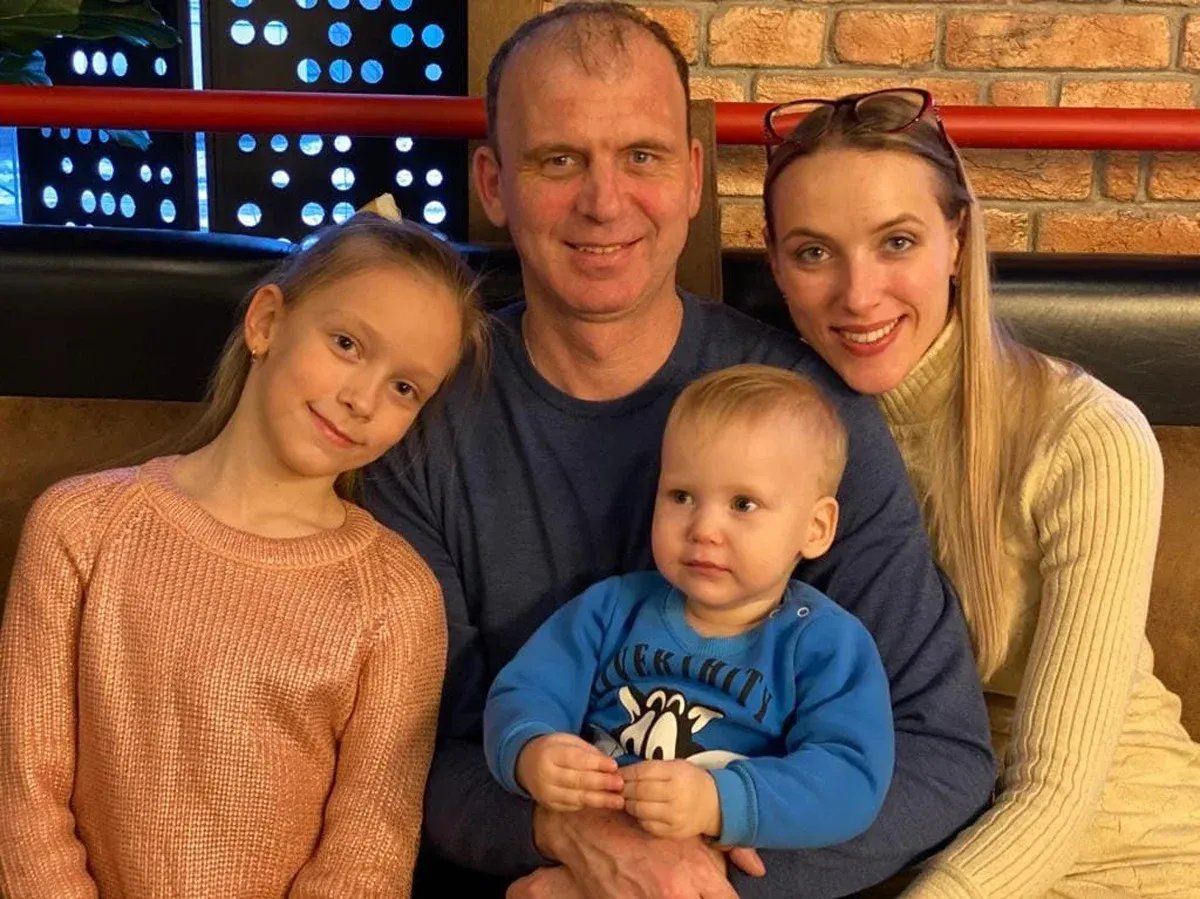
Mikhail Afanasyev with his family.
‘No truthful pen,’ writes that ever-our-own Saltykov-Shchedrin, ‘will ever undertake to erase from existence something that, even if not to the same degree, is felt by everyone as the fundamental and burning pain of the moment.’
I care about the circumstances surrounding the deaths of three children in a fire at Askiz railway station, including the failure of local emergency services to prevent the tragedy from escalating and save the children from death.
I care about the circumstances surrounding the death of a driver inside his truck cab in Sorsk, and the employer’s subsequent unfair treatment of his family.
I care about fathers who lost their wives and children in maternity hospitals. Today, all of them have new families, and new babies have been born. I have witnessed the church weddings of some and become the godfather to the children of others.
I care about mothers whose children, even though they were already adults, were murdered, while those responsible for the crimes escaped accountability.
I care about the forgotten icon of the Albazin Mother of God–now returned to one of the churches in Abakan–and about preserving the memory of children who died more than 60 years ago in a horrific disaster near Minino.
Everything that happens in Khakassia matters to me because I am a journalist, and every person is my fellow human being. I entered journalism not to turn a blind eye to injustice and the ills afflicting society. I cannot simply sit back and tell my children about remaining faithful to the ideals of humanism while ignoring a bereaved father seeking justice, a forgotten hero of an uprising, or the abuse of power directed at an OMON officer from my own city. I seek neither power nor money. I simply want to stand alongside the humiliated and the wronged, to defend their dignity through my words and publications, and to pursue justice together with them, encouraging the authorities and the public to engage in a dialogue about how we can tackle the ills of our society together.
This is precisely what makes me a human being and a journalist, and precisely why every injustice in Khakassian society matters to me.
‘Even the most downtrodden, the lowliest person is still a human being, and he is called my brother,’ preached Vissarion Belinsky. ‘The mystery of human existence lies not in merely staying alive, but in what one lives for,’ wrote Dostoevsky. ‘Every person lives not by concern for themselves, but by love,’ Leo Tolstoy emphasised. And I would far rather make a mistake–even through no fault of my own–when giving the date of a combat engagement or reporting that there were human casualties in an article than pass indifferently by this painful and terrible subject.
The renowned Soviet writer Yulian Semyonov, discussing precisely a journalist’s mistake in his novel Confrontation, made a particularly important point: ‘A mistake is beneficial to society. It is the result of a search.’
I have not even mentioned that the European legal framework on freedom of expression in force at the time of publication explicitly permits errors in journalistic material investigating a social problem. After all, as I have said, a journalist is not an investigator seeking to establish an incontrovertible legal truth. A journalist uses words to draw attention to society’s problems and failings.
And I know one more thing for certain: it is society’s duty to stand up for police officers, because genuine police officers protect society and every person within it. This is what is known throughout the civilised world as civil society.
Victor Hugo believed that ‘Right, when triumphant, has no need to resort to violence. Right is all that is true and just’ (Les Misérables). I have always dreamed of establishing a newsroom where anyone–regardless of profession or social status–could come and speak about their problem or tragedy, and find their rights defended through the words of true ‘guardians of society’, carrying on the great work of Belinsky, Gogol, Dostoevsky, Saltykov-Shchedrin, Nekrasov, Pushkin, Leskov, Rousseau, Dumas, Herzen, Hugo, Turgenev, and many other champions of humanity. Every person is my brother.
But if it has come to pass that the full force of a legal fact has been brought to bear against the law and the rights it is meant to protect, then I have no choice but to remain faithful to the values of journalism, the profession that has given my life its meaning.
I want to address my children. May what has happened to me never shake your faith in the good that exists in people. Remember what we have talked about: helping the weak, showing mercy, and loving others are the very best things within you. And there are no words such as ‘must’ or ‘ought to’–there is one word: ‘need’. I love you so much! Everything will surely fall back into place. The only thing you must never lose is your faith in humanity.
In conclusion, I would like to ask the court not to destroy the computer that has been admitted as evidence in this case. It contains the unique results of ten years of work to reconstruct the circumstances of the tragedy at Minino railway station, as well as the findings of my efforts to restore the memory of our fellow countryman, Sergei Saburov, a hero of the 1985 uprising at Badaber Fortress. Most importantly, it contains photos and videos of my children–memories that will be impossible to recover.
I would like to conclude with my favourite message to the Russian intelligentsia by the great Mikhail Saltykov-Shchedrin: ‘Recognise your own strength, then, but not so that you may indiscriminately bestow your kisses upon truth and falsehood alike. Rather, use it to provide moral support for conscientious and honest convictions. Indeed, without such support, it is impossible to build anything lasting.’
Thank you for hearing me out.
29 August 2023
Abakan City Court, Abakan, Russia
Source: Novaya Gazeta
More about the case: Novaya Gazeta
Photo: Alexey Tarasov/Novaya Gazeta, Network Freedoms, Mikhail Afanasyev’s personal archive